
| Last updated date: | Reason for update: |
|---|---|
| 06 July 2026 | Alignment with ARPANSA-GDE-2321. |
Selecting the correct application form
Submissions should be competed via the Regulatory Administration Database RAD Portal. The Portal will automatically populate the form with the relevant questions, depending on the selections made.
Alternatively, there are 3 source licence application forms - the choice of form depends on the hazard of the source(s): Group 1 sources are considered low hazard, Group 2 sources are considered medium hazard and Group 3 sources are considered high hazard. Section 4 of the Australian Radiation Protection and Nuclear Safety Regulations 2018 (the Regulations) describes the types of sources in each group and this will assist you to select the correct application form.
Associated forms
- Licence application form – low hazard source
- Licence application form – medium hazard source
- Licence application form – high hazard source
Completing the application form
This guide is to assist applicants filling out the licence application form.
- The information within the submission needs to help the CEO of ARPANSA to decide on whether the implications for safety of your proposed dealing will be satisfactorily managed
- The proposed dealing should be mature, and the submission should be an objective appraisal of the safety of the dealing.
- The amount of information in responses should be proportional to the complexity of the dealing you are proposing. If any of the headings included in the form are not relevant or do not need to be considered for this dealing, explain why in the appropriate section
- The contents of the submission should follow a ‘claims, arguments, evidence’ structure. This refers to the way in which applicants should demonstrate that the information provided is relevant and sufficient to meet ARPANSA’s requirements and for the CEO of ARPANSA to grant approval
- Claims should be a simple statement of actions or considerations that have been or will be taken
- Arguments should explain why this action or consideration is relevant to both safety and the heading under which it is included
- Evidence should support the claim and argument being made and can include additional documents (e.g. risk assessments, work instructions, engineering diagrams) submitted alongside the completed application form. All additional documents provided should have a clear reason for being included in the submission.
- All photographs, diagrams or graphs provided should be referred to within responses. Explanations should be provided of their content and relevance. These items should be properly formatted (e.g. graphs should have labelled axes). If particular aspects of these items are relevant, these aspects should be identified (e.g. highlighted, circled, identified using arrows)
- If the applicant is referencing a specific part of a provided document, this reference should direct to a specific section/page/paragraph.
Section A: Applicant Information
Department or Commonwealth entity
Name of the Department or entity on behalf of which the application is being made. It may include further information for ease of identification, e.g. Division, Branch, Section. The applicant/licence holder should provide their ABN or name listed on the Commonwealth entities and companies Directory.
Portfolio
Name of the Commonwealth ministerial portfolio in which the Department or entity resides.
Applicant/responsible person
The application must be made by the chief executive of the Department or entity, or by a person authorised by the chief executive.
The applicant must provide their full name and position. If it is made by an authorised person, the application must include a copy of the authorisation.
Note 1: Responsible Person in relation to any radiation source, prescribed radiation facility or premises on which radiation sources are stored or used means the legal person: (a) having overall management responsibility including responsibility for the security and maintenance of the radiation source, facility or premises (b) having overall control over who may use the radiation source, facility or premises (c) in whose name the radiation source, facility or premises would be registered if this is required. RPS C-1 Code for Radiation Protection in Planned Exposure Situations
Nominee
If the applicant is physically removed from the source dealing, such that they cannot demonstrate effective control, the name and contact details of a person more directly in control of the source dealing must be provided. This nominee must be in effective control of the sources. Generally, the nominee will be the manager of a division or agency’s operation at the site of the proposed activity or, in the case of mobile or portable devices, where the devices are usually stored. Another nominee may be acceptable where the hazards of the activity are low and only minimal control is required. If a nominee is appointed, an organisational chart should be provided showing the relationship of the nominee to the applicant and end users.
Radiation Safety Officer (RSO)
This is an individual appointed by the applicant to supervise radiation safety in relation to the sources for which the licence is sought. This person must be technically competent in radiation protection matters relevant to all sources, including non-ionising radiation sources if these are part of the application. Evidence of competency should be included. If there is more than one radiation safety officer, the details of other radiation safety officers should also be provided.
Note 2: An RSO may not always be required. Applicants should refer to the Regulatory Guide: Plans and Arrangements for Managing Safety, or contact ARPANSA.
Declaration
The declaration must be signed by the applicant or authorised person.
Section B: Description of the source and proposed dealing
Indicate the kind of controlled apparatus and/or controlled material in the table provided. If there is any doubt about the hazard category or description of a source the applicant should seek advice from Regulatory Services on (02) 9541 8333.
Describe the source, the proposed dealing, and provide the full site address where the sources will be used or stored.
Section C: Source details
Section 47 of the Regulations sets out the information that must be provided about the sources to be dealt with under the licence. This must include the information shown in the table below.
| A dealing with a sealed source | (a) the nuclide, activity, chemical form, encapsulation material and physical form of the sealed source (b) the purpose and identification details of the sealed source (c) the place where the sealed source is to be located (d) a copy of any sealed source certificate for the sealed source |
| A dealing with an unsealed source | (a) the nuclide, chemical form and physical form of the unsealed source (b) the purpose and identification details of the unsealed source (c) the maximum activity of each nuclide to be held on particular premises at any one time (d) the place where the unsealed source is to be located |
| A dealing with a controlled apparatus that produces ionising radiation | (a) the purpose and identification details of the controlled apparatus (b) the maximum kilovoltage (c) the place where the controlled apparatus is used |
| A dealing with a controlled apparatus that produces non‑ionising radiation | (a) the purpose and identification details of the controlled apparatus (b) the likely exposure levels including the nature of the radiation (c) all output parameters relevant to the likely exposure conditions (d) the place where the controlled apparatus is used |
The details of any sources must be recorded in a source inventory. These can be added using the RAD Portal or a format approved by the CEO.
Once the licence application has been approved the source inventory should be maintained using the RAD Portal.
Section D: Plans & arrangements for managing safety
The applicant must have plans and arrangements for managing sources to protect people’s health and safety and the environment (s47(1)(d) of the Regulations). These should form a comprehensive program of policies, procedures and instructions that show how safety and security will be maintained. Together, they make up the applicant’s or operator’s management system. While the system must meet ARPANSA’s expectations, it should be written for the organisation’s own effective management, not just for ARPANSA. The level of detail should reflect the hazards and complexity of the sources involved.
There is no predetermined format for these plans and arrangements. The applicant should describe them in the application form and refer to suitable organisational documents attached to the application. For lower-risk applications, a detailed description in the form may be sufficient for ARPANSA’s review, provided it identifies and references the key management system documents. ARPANSA expects licence holders to “say what they will do, do what they say, and show what they did”. This principle underpins ARPANSA’s regulatory oversight, and the plans and arrangements are central to demonstrating it.
A brief description of what is expected in plans and arrangements is provided below. For more detailed information, refer to Regulatory Guide - Plans and Arrangements for Managing Safety.
Applicants should identify the codes and standards relevant to the proposed dealing and describe how these will be implemented or taken into account in managing the safety of sources. This information may be incorporated into Section D of the licence application.
Codes and standards applicable to each kind of source can be found on the ARPANSA website. These codes and standards will become conditions of licence should the application be approved.
ARPANSA publishes information about international best practice (IBP) with links to international codes and standards that may be relevant to the proposed dealing. The applicant is advised to consider these where relevant.
Depending on the type of source, the applicant may be required to address some or all of the following:
Effective Control Arrangements
Provide information to demonstrate how the applicant or nominee will maintain control over the particular dealings for which a licence is sought (s47(1)(d)(i) of the Regulations). The arrangements should cover such things as organisational arrangements, management systems and resources.
Safety Management
Describe the administrative arrangements for managing safety (s47(1)(d)(ii) of the Regulations). These arrangements may be minimal, where only low hazards are involved, but will be more extensive for dealings of higher hazard or complexity. The safety management plan should cover things such as safety culture, safety of premises and equipment, competency and training, incidents, auditing and record keeping.
Radiation Protection Plan
Radiation protection policies and procedures should be set out in a radiation safety manual and in specific operating procedures (s47(1)(d)(iii) of the Regulations). Guidance on the content of such a manual is provided in chapter 3 of RPS C-1 Code for Radiation Protection in Planned Exposure Situations.
The radiation protection plan should cover issues such as principles of radiation protection, planning and design of the workplace, classification of work areas, local procedures, radiation monitoring of individuals and the workplace and protection of the environment.
Where sources are to be used for medical purposes, the plans and arrangements should address the requirements of RPS C-5 Code for Radiation Protection in Medical Exposure and associated safety guides for diagnostic and interventional radiology, radiotherapy, and nuclear medicine; in particular, addressing optimisation of exposure and radiation protection of the patient.
In addition, the applicant is responsible for ensuring that arrangements are implemented for the appointment of a suitably qualified radiation safety officer and/or radiation safety committee as appropriate. Information should be provided about the qualifications and experience of such persons and the arrangements in place for their continued competency.
Radioactive Waste Management Plan
A full description and anticipated amounts of any radioactive wastes, including discharges arising from the proposed dealing and the arrangements for the safe handling, treatment, storage and disposal of any such waste should be set out in a radioactive waste management plan (s47(1)(d)(iv) of the Regulations).
Refer to RPS C-6 Code for the Disposal of Radioactive Waste by the User, RPS G4 Guide for Classification of Radioactive Waste, and relevant IBP.
Ultimate Disposal or Transfer Plan
Provide a plan for the ultimate transfer or disposal of sources (s47(1)(d)(v) of the Regulations). Copies of documented undertakings by other organisations to accept sources when no longer required should be provided where possible. Applicants should note that after a licence is issued, section 65 of the Regulations applies to the disposal and transfer of sources.
Note 3: Stricter requirements apply to security enhanced sources - applicants should refer to RPS 11 Code of Practice for the Security of Radioactive Sources.
Security Plan
Describe the arrangements for the security of sources to prevent theft, damage or unauthorised access (s47(1)(d)(vi) of the Regulations). These arrangements should ensure that control of sources is not relinquished without appropriate approvals required by the Regulations and conditions of licence. The plan should provide for periodic inventory checks to confirm that all sources are secure and in their assigned location.
Refer to RPS 11 Code of Practice for the Security of Radioactive Sources. Compliance with this code is mandatory for security enhanced sources - in particular the need for an endorsed security plan.
Note 4: A security enhanced source is a radioactive source or aggregation of sources assigned Security Category 1, 2 or 3 when using the methodology set out in Schedule B of RPS 11.
Emergency Plan
Emergency arrangements must be developed for all foreseeable emergencies such as dispersion of materials, overexposure of operators, or theft or loss of controlled material (s47(1)(d)(vii) of the Regulations). The arrangements should include: the responsibilities of all parties in the event of an emergency; contact arrangements; emergency procedures; emergency equipment; and reporting arrangements. Where necessary, arrangements for involving external agencies such as police and other emergency services should be included.
The plan should include arrangements for testing the emergency arrangements through regular reviews and exercises and rectifying any deficiencies found in the emergency plans.
Refer to RPS G-3 Guide for Radiation Protection in Emergency Exposure Situations.
Section E: Matters to be taken into account by the CEO
Subsection 33(3) of the Australian Radiation Protection and Nuclear Safety Act 1998 (the Act) requires the CEO to take into account international best practice in relation to radiation protection and nuclear safety when making a decision whether to issue a source licence. The CEO must also take into account the matters prescribed in section 54 of the Regulations. Provide information on these matters in Section E for the CEO to consider.
International best practice in radiation protection and nuclear safety
Scope: This submission should demonstrate that all aspects of the change are in line with current best practice as evidenced by international standards, collaboration, or precedent.
The applicant should demonstrate that international best practice has been considered in relation to the dealing (s33(3) of the Act). If there are aspects of the dealing which do not require the consideration of international best practice, explain why not.
Submissions will be assessed on international best practice by taking account of the following:
- Conformance to international standards and guidance published by reputable international bodies. Whilst there are many such bodies, ARPANSA’s CEO has produced a list of organisations whose publications represent international consensus. Publications from other reputable organisations may also be considered relevant
- Identification of similar work having been conducted internationally
- Engagement and collaboration with international experts
- Collaboration with international industry partners
- Evidence of following the precedent set by international counterparts, or applying lessons learned from issues they have faced.
Refer to the International Best Practice page for further information.
Undue risk
Scope: Undue risk is a risk that is unnecessary or excessive. Measures for controlling radiation risks must ensure that no individual bears an unacceptable risk of harm, and that the environment is protected.
The submission should demonstrate consideration of undue risk (s54(c) of the Regulations).
The normal exposures to workers and the public should be as low as reasonably achievable (see optimisation below) and less than the relevant dose limits. Undue risk arguments should consider the risks that may be incurred in worst-case scenarios, emergencies or other instances where unexpected or unintended events may occur.
If potential exposures (i.e. impact) to workers and the public in worst-case scenarios are greater than the relevant dose limits, the likelihood of these exposures should be reduced to a level that is not expected to occur. The acceptable level of likelihood for these types of potential exposures should be commensurate with the magnitude of the exposure (i.e. the higher the magnitude, the lower the likelihood). However, where a consequence is high, a deterministic approach should be considered where the event leading to exposure is assumed to occur and controls or mitigations are put in place regardless of the likelihood of occurrence. Where mitigation action is planned to reduce the consequences of any anticipated abnormal occurrence, this action should adopt the principles of optimisation described in the Optimisation of protection section below.
The radiation protection principle of limitation is relevant to this heading. Further information on this concept can be found in ARPANSA Radiation Protection Series F-1 under the heading ‘Limitation of risks’.
Submissions will be assessed on undue risk by taking account of the following:
- The applicant’s management system (their plans and arrangements) to determine reasonable assurance that the dealing will be undertaken safely. The assessor will use a holistic approach that considers the interaction of technical, human, and organisational factors
- The inherent risks and residual risks of the dealing after the application of risk mitigating controls. The assessor needs to understand the likelihood that these controls will be properly applied to the dealing.
Net benefit
Scope: The submission should show that the proposed activity is warranted by providing a net benefit to individuals or society (it should do more good than harm). That is, the dealing should be justified, considering societal, economic and other relevant factors.
The radiation protection principle of justification is relevant to this heading. The submission should demonstrate the benefit of the dealing, taking account of the potential harm as well as the desired positive outcome. The benefits considered should be specific and a direct result of the dealing (s54(d) of the Regulations).
Net benefit arguments should weigh up the benefits and harm the planned work would entail. For example, if a worker is expected to receive a dose, this would need to be justified in terms of the benefit the dealing would bring about. It should be based on the expected safety risks rather than the worst-case scenarios. Consideration of worst-case scenarios outside of the planned work should be outlined in the Undue Risk section.
Further information on the principle of justification can be found in ARPANSA Radiation Protection Series F-1 under the heading ‘Justification’.
Submissions will be assessed on net benefit by taking account of the following:
- The information provided to see whether the benefits of the dealing outweigh the potential harm to the community and the environment
- The level of net benefit to the community, research or other special populations
- The impact on future doses and potential exposures associated with waste management and ultimate disposal.
Optimisation of protection
Scope: Optimisation refers to the processes for managing the magnitude of individual doses, the number of people exposed, and the likelihood of exposure, being As Low As Reasonably Achievable (ALARA), taking into account economic and societal factors.
The submission should demonstrate consideration of optimisation of protection (s54(e) of the Regulations). Optimisation should also be applied to mitigation actions associated with anticipated abnormal occurrences. There is no lower limit below which the process of optimisation should cease. However, the submission should take a graded approach to demonstrating an optimal solution has been achieved. For instance, far greater effort and detail of analysis would be expected for high hazard sources than for low hazard sources.
Submissions will be assessed on optimisation of protection by taking account of the following:
- The number of people affected and the magnitude of normal exposures
- The number of people affected, the magnitude, and the likelihood of potential exposures
- The interface whereby the controls applied or the approach adopted for managing either normal or potential exposures affects other exposures
- The selection of suitable constraints for dose and risk for planned exposures. The dose and risk constraints should be set to drive good practice and continuous improvement in radiation protection
- The identification of protection options and the selection of the best option given the prevailing circumstances
- The effectiveness of implementation of the selected option.
Technical, human and organisational factors
Scope: The submission should acknowledge interactions between people, technology and the organisation in relation to safety.
The submission should demonstrate a holistic approach to safety and security by providing evidence that technical, human and organisational factors have been considered and managed throughout all aspects of the dealing (s54(ea) of the Regulations). ARPANSA provides definitions of, and guidance on, technical, human and organisational factors in ARPANSA’s Holistic Safety Guide.
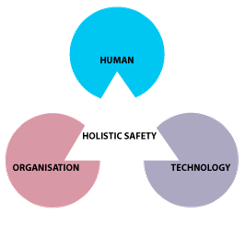
Examples of specific factors which can be considered within a submission are given below. Not all of these factors, or the questions provided alongside them, may be relevant to all submissions.
ARPANSA assessors may assess consideration of technical, human, and organisational factors by taking account of some or all of the following:
Technical factors
Hierarchy of controls: Are controls and mitigations set at an appropriate level? Is there evidence of the effectiveness of these controls?
Human-technology interface: Is all required information provided to the operator by the machine interface (e.g. control panel, display screen) in an understandable and legible manner? Has the implementation of any technology impacted the way in which work is done, and has this been considered in safety and risk assessments?
Human factors
Expertise & training: Do staff possess the necessary expertise and competencies? Have staff received the necessary training? How are these aspects measured and verified?
Equipment design: Has the design of equipment been user-centred? Is equipment human-error tolerant/evident?
Human limitations: Have processes been designed to account for human factors/limitations? For example, fatigue, cognitive demand, physical limitations, the operational environment.
Non-technical skills: Have non-technical skills been considered? For example, leadership, communication, teamworking.
Organisational factors
Safety culture: Does the organisation have clearly recognised values, and is there evidence that they are upheld? Is there an open reporting culture within the organisation? Is there a clear history of safety and security forming part of decision-making?
Leadership and management structure: Are there clear reporting lines and points of accountability? Is this true of any temporary arrangements made to reporting lines or work teams? Are there single points of accountability for each element important for safety? Do leaders model a commitment to safety and security? Do leaders seek out operational information, both good and bad?
Resilience: Has the organisation demonstrated the ability to respond, monitor, learn and anticipate?
Guidance on what interactions to consider can be found in the Regulatory Guide - Holistic Safety.
Capacity to comply
Scope: Capacity to comply refers to the licence holder’s ability and willingness to comply with all legislative requirements under the Act, the Regulations, and licence conditions. Considerations of whether licence holders have the resources, organisational support and willingness to comply with the Act, the Regulations and any licence conditions are of relevance.
Submissions will be assessed on capacity and willingness to comply by taking account of the following (s54(f) of the Regulations):
- The compliance history if the applicant is an existing licence holder, and any developments which may raise concerns regarding capacity or willingness to comply in the future. Any self-assessment applicants make of their own compliance history should be brief and objective.
- Availability and commitment of resources to safety, and the proposed dealing generally Applicants should demonstrate that sufficient resources are dedicated to the dealing to ensure the proposed dealing is carried out safely
- The impact of competing goals and priorities on safety and organisational performance. Applicants should demonstrate a capacity and willingness to manage competing goals and priorities to ensure the management of safety
- Leadership and the organisational structure of the applicant. This includes the presence of clear lines of accountability and responsibility which serve to enhance capacity and willingness to comply
- Safety culture, including the regulator-applicant relationship and its impacts on capacity and willingness to comply
- The maturity of the applicant’s management system. This includes the requirements of s57 to s58 (inclusive) of the Regulations, and whether the applicant has the tools available to support critical safety functions and ongoing compliance requirements. In pre-operational phases this will include aspects such as the management of quality and non-conformance.
- The presence and effectiveness of organisational measures to control safety, e.g. independent safety assessment, review, and inspection/audit functions
- Staff being suitably qualified, experienced, and capable of covering both normal operations and emergency conditions. Applicants should show they are both capable and willing to follow procedure.
Where an applicant is an existing licence holder how it has learned from past incidents and accidents.
Authorised signatory
The application must be signed by an office holder of the applicant or a formally authorised person. An office holder is the Secretary, Chief Executive Officer or an equivalent person of the Department or entity that is named as the applicant. Where a person authorised by an office holder of the applicant signs the application, a copy of the instrument of authorisation must be provided.
Checklist
A checklist is provided to confirm the application is complete.
Application fee
Refer to section 49 of the Regulations to determine the appropriate fee. The fee must be received before the application can be assessed. Accepted payment methods are EFT, credit card or BPAY – please see Payment methods | ARPANSA.
Submitting your application
Application should be submitted via the RAD Portal together with all supporting documentation. Alternatively contact ARPANSA for advice on how to submit documentation, particularly any documentation that is of ‘protected’ or higher classification.
How your application will be processed
When your application is submitted it will be examined to see if all the necessary information is included, if it is properly signed, and if the correct application fee has been paid. If so, you will receive an acknowledgment email. If any of the basic information is missing, you will be contacted for further information or in some cases the application and fee may be returned.
Your application will then be forwarded to a regulatory officer. The regulatory officer will discuss and agree a time with you to complete the assessment.
The regulatory officer will review all the information and consider the claims, arguments and evidence presented. Where matters require clarification, the regulatory officer will contact you or your nominee. The regulatory officer may also consider that an inspection or site visit is necessary and will contact you to arrange this. The officer will then prepare a regulatory assessment report to document the review.
The assessment report will make a recommendation to the CEO about whether to issue a licence and may recommend licence conditions to be imposed under section 35 of the Act. The report undergoes a rigorous review and approval process prior to being sent to the decision maker with all relevant documentation. You will be advised in writing of the decision.
Under section 37 of the Act, a licence may be issued indefinitely or for a period specified in the licence. When issued, a licence remains in force until it is cancelled or surrendered, or the specified period has elapsed.
Appealing a licence decision
Section 40 of the Act describes the rights of review available to eligible persons in respect of licence decisions made by the CEO. The following decisions are reviewable:
- to refuse to grant a licence
- to impose conditions on a licence
- to suspend a licence
- to cancel a licence
- to amend a licence
- not to approve the surrender of a licence
- to issue a licence for a particular period, rather than for a longer period or indefinitely
- not to extend the period for which a licence was issued.
An eligible person in relation to a decision to refuse to grant a licence means the person who applied for the licence, and in relation to any other licence decision, it is the licence holder.
Review by the Minister
Should an applicant wish to have a licence decision reviewed, the applicant may request the Minister for Health to review the decision. The request must be in writing and be given to the Minister within 28 days of the making of the licence decision. Once a request for review has been lodged, the Minister must reconsider the licence decision and confirm, vary or set aside the decision.
The Minister is taken to have confirmed the licence decision if the Minister does not give written notice of the Minister’s decision within 60 days of the request.
Review by the Administrative Review Tribunal (ART)
An application may be made to the ART for review of a decision of the Minister.